Regula falsi: proofs and convexity
The method of regula falsi: the chord, the proof that it stays inside the bracket, and a convex function where one end stays in place and the method converges, and a proof that it converges to the root, without convexity, when the root is unique.
Last updated:
On the page about the intermediate value theorem and bisection we solved the monthly-payments equation on the bracket by bisection, and proved that bisection cannot fail.
Here we also use the size of , and prove what this gives and what it costs.
Regula falsi: use the values, not only the signs
Bisection throws away information: in the table of bisection, at the value is far from zero, at it is , very close.
Another candidate, besides the midpoint, is where the chord, the straight line through and , crosses zero.
Work it out: at which point does the chord cross zero?
Write the equation of the line through the two points, and substitute .
Solution
The slope of the chord is , and its equation is .
At the point we have :
A common denominator gives one fraction:
The denominator is not 0, because in a bracket whose ends are not roots and have opposite signs.
Where the formula for comes from, step by step, in a short video of mine (in Hebrew):
The point where the chord crosses zero is
This is regula falsi (Latin for “rule of the false position”).
Keep the side where the sign changes, as before. What it adds:
it uses how big is, so when is close to a straight line, as the present value of payments nearly is, the chord lands very near the root.
Its cost: the bracket no longer halves, and one end can stay stuck.
Check yourself: what is the first point of regula falsi for on ?
Which part of the bracket is kept?
Solution
and , so
, so the sign changes between and 2, and the bracket is kept.
Bisection would have tested .
The column has the same meaning as on the first page:
negative means that a debt remains, so the rate is too high.
The last column is the ratio of two consecutive steps, ; it needs three points, so its first three rows are empty (row 0 is the starting bracket and row shows , and the new bracket ).
| 0 | – | – | 0 | 0.05 | – |
| 1 | 0.02950611 | −6.265 | 0 | 0.02950611 | – |
| 2 | 0.02804218 | −0.4455 | 0 | 0.02804218 | – |
| 3 | 0.02793845 | −0.03156 | 0 | 0.02793845 | 0.0709 |
| 4 | 0.02793111 | −0.002235 | 0 | 0.02793111 | 0.0708 |
| 5 | 0.02793059 | −0.0001583 | 0 | 0.02793059 | 0.0708 |
| 6 | 0.02793055 | −0.00001121 | 0 | 0.02793055 | 0.0708 |
The step ratio can be computed without knowing the root, since only the points themselves are needed; here it is about , so the error shrinks about 14-fold per step.
What the ratio tells us about the error is in the step-ratio section of the rate-of-convergence page.
The explorer below runs both methods side by side; switch between them and watch the chord land closer to the root.
The explorer needs JavaScript. The tables below show the first steps of both methods on the monthly payments.
Proof: regula falsi stays inside the bracket
Work it out: In a bracket whose ends are not roots and have opposite signs.
Write the point as , and find in terms of and .
Solution
.
Two facts follow from the signs, each in the two possible cases.
If , then
and if , then
In both cases (1) (subtracting a number of the opposite sign adds the absolute values), and (2) and have the same sign, so the quotient is positive and equals the quotient of the absolute values:
It is less than 1 because (the signs are strictly opposite, so ), which makes the denominator larger than the numerator.
The point is a weighted average of the ends, where the weight of each end is the value of at the other end:
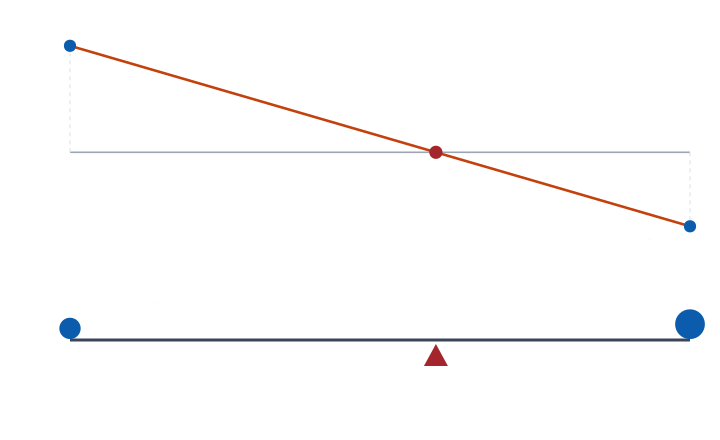
In the monthly-payments table the first step has with and with , so and :
nearer the end where is smaller. An everyday image is a lever with two weights:
put the weight at and the weight at , and the point is where it balances, the centre of mass, nearer the heavier end, , which carries the larger weight because is the smaller value.
In a bracket whose two values are not zero, , so strictly.
If we have found a root; otherwise we keep the side where the sign changes, exactly as in Claim 1 of bisection, and the bracket stays a bracket.
So regula falsi, too, always keeps a root inside its bracket; that the points converge to it we prove below for a convex function.
The bracket no longer halves: replaces the end where has the same sign as , and the other end may stay.
Proof: when the function is convex, one end stays in place
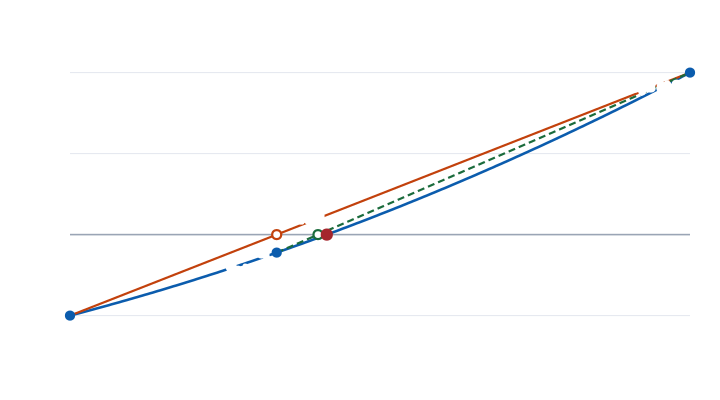
A function is convex on an interval when each of its chords lies above the graph or on it (for example , on a positive interval, and the monthly-payments function: a sum of convex functions is convex (add the chord inequalities of the terms), and each is convex: its second derivative is positive).
The figure shows the graph of and the chord through the ends and .
Convex and concave: a picture
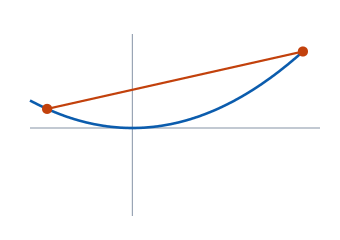
The definition above says the chords of a convex function lie above its graph:
the graph is a bowl opening upward, like . Turn the inequality around and the function is concave:
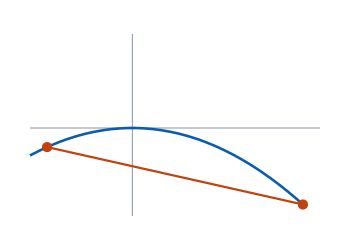
every chord lies below the graph (or on it), and the graph is an arch, like .
A function is concave exactly when is convex.
In formulas, convex means for all in the interval and every :
the left side is the graph above the point between and , the right side is the chord above that same point.
Some books say “concave up” for convex and “concave down” for concave; the chord test above gives the same answer whichever names a book uses.
Claim 4. Let be continuous on the closed interval and convex there, with .
Then in every iteration of regula falsi either is a root (and we are done), or , the left end does not move (), and the right end moves strictly to the left ().
In short: at every step, and the end where is positive never moves.
Proof by induction on . Let be the statement: and (where ).
Base (). and, by assumption, . So holds.
Hypothesis. holds for some : and .
Step (from to ). Iteration starts from the bracket , where .
Its point is the zero of the line through and , and it lies strictly between and (by the previous proof).
is convex on , a part of the interval where it is convex, so its graph lies below this chord:
If we found a root. Otherwise , so and the rule keeps :
, and . This is .
Conclusion. By induction holds for every (as long as no root was found):
never moves, every new point has , and for every , that is, decreases strictly.
The other cases. If (as for on ), the same proof works with the ends exchanged:
becomes ” and ”, the chord is above the graph, so again , the rule keeps , and the end where is positive, , never moves while increases strictly.
If is concave, apply the claim, or its mirror case above, to :
it is convex, has the same roots, and regula falsi produces the same points for it (the zero of the chord does not depend on the sign of ).
Hence at every step, the end where is negative never moves, and the other end approaches the root from one side only.
Work it out: Why is there only one root in the bracket? (Hint: suppose are both roots, and write as a point between and .)
Solution
with . By convexity , contradicting .
So has exactly one root in (it exists by the intermediate value theorem, since is continuous), it is positive to its left (since ) and negative to its right.
Convergence. Write ; at iteration the new point is (here , so the right end moves to it).
For every , (, and for with by Claim 4), so ( is positive on : it is positive at , continuous, and has no root other than ); and (the new point is inside the bracket, by the previous proof), so for every , that is, :
the numbers decrease and are bounded below by , and therefore the limit exists (a bounded monotone sequence converges) and .
The formula gives in the limit (here we use that is continuous on the closed interval: convexity alone allows a jump at an end), after multiplying by the denominator (not 0, because ):
, so and : regula falsi on a convex function converges to the root (convergence without convexity is proved below).
When (as for on ) the roles are exchanged:
the end stays and the end rises toward the root.
A concave function is handled through , as in Claim 4:
the theorem holds for it, at every step, the end where is negative stays, and the other end moves monotonically to the root.
Proof: convergence without convexity
The proof above needed a convex function. Here is what holds for every continuous function with a bracket.
Write for the bracket after iteration , with .
If some is a root, the method has found it and stops; so we assume that no is a root, and then at every step.
Claim 5. Let be continuous on with . Then:
- The numbers do not decrease and the numbers do not increase, so the limits and exist, and .
- : at least one of and is a root.
- Every limit point of the points is a root of (a limit point is a number that some of the points approach: the limit of for some ).
- converges to a root, unless and both are roots. In particular, if has only one root in (for example when is convex or concave), then .
Step 1 (the ends are monotone). The new point lies strictly between and (the proof that regula falsi stays inside the bracket), and the new bracket is or .
Hence for every : the numbers do not decrease and are bounded above by , and the numbers do not increase and are bounded below by .
By the reminder from calculus both limits exist, and because .
Also, is an end of the new bracket: or .
Step 2 (). By continuity, , and a limit of negative numbers is at most 0.
Step 3 ( is impossible). Suppose .
Then (if the product is ) and , since the values have opposite signs.
The zero of the chord through and is
and it lies strictly between and (a weighted average with positive weights).
The formula for is the same expression with in place of ; its numerator and denominator are continuous, and the denominator tends to , so .
But each equals or , with and , so every limit point of is or , not :
a contradiction. With Step 2, , which is part 2.
Step 4 (the limit points are roots). By Step 1 every limit point of is or .
There are three cases.
- . Then , so is a root, and lies between and , so .
- and exactly one of is 0. If , the denominator of tends to and , a root. If , in the same way , a root.
- and . Both limit points and are roots.
In every case each limit point is a root: this is part 3. In the first two cases converges to a root, which is part 4.
If has only one root in , the third case cannot occur (it has two roots), so .
Conclusion. For every continuous with a bracket, the ends of the bracket converge, at least one limit is a root, and every limit point of the points is a root.
When the root in the bracket is unique, converges to it, with no assumption of convexity.
What we did not prove. When has several roots, it may be that and both are roots, with both ends moving forever.
Then the argument shows only that every limit point of is a root; we do not claim that converges, and we do not know whether this case can occur.
The proof also says nothing about the rate, or about one end staying fixed:
for these we used convexity.
Each step shrinks the error about 14-fold (we define and measure the rate in the page on the rate of convergence) and stays at 0 while moves, as Claim 4 says of a convex function:
in this table that is harmless.
To reach , regula falsi needs 11 steps on the monthly payments and bisection 40 (in the explorer, with the tolerance set to ); the counts follow the stopping rule of the explorer, and also , not the width formula alone.
In the explorer, choose the example “Fixed end: x^10 − 1”: the function on .
The curve is flat near 0 and steep near the root, and at every step the new point falls on the same side of the root.
So the right end stays fixed at 1.3, and the left end advances slowly toward the root (0, 0.094, 0.18, 0.26, and so on):
the method converges, but slowly:
| Steps to reach | Bisection | Regula falsi |
|---|---|---|
| Monthly payments, | 40 | 11 |
| , | 36 | 104 |
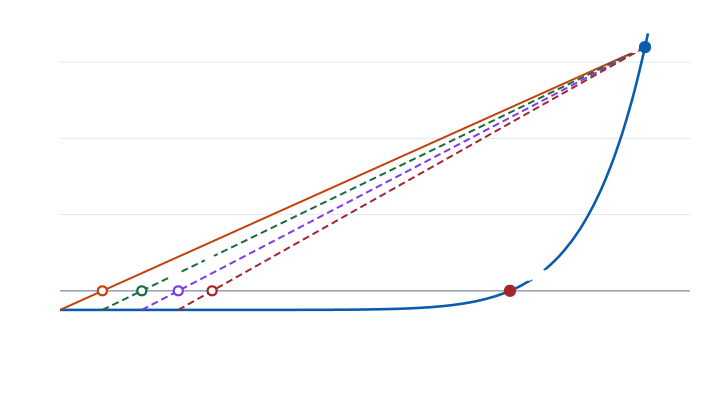
is convex on and , so by Claim 4 the right end stays at 1.3 and the left end advances in small steps:
this is exactly what the figure shows. In regula falsi the of the explorer is , not a bound on the error:
for the error is several times the last step (how many, we compute in the step-ratio section).
In real libraries regula falsi does not keep an end fixed: the function falsepos of GSL adds a bisection step whenever the chord step shrank the bracket by less than half.
The Roots.jl library also implements variants that reduce the value of at the fixed end.
In our computation, on in , such a change (the Illinois method: when the same end stays in place twice in a row, its value of is halved so that the chord moves; we do not teach it here) reaches in 14 steps, against 104 for plain regula falsi and 36 for bisection (stopping by alone).
Press Compare all methods to see both error curves. Bisection goes down on average along a straight line on the log scale, a gain of one binary digit per step; regula falsi can be faster or slower, depending on the shape of .
Summary: bisection and regula falsi
| Method | Needs | Guaranteed | Speed | Weakness |
|---|---|---|---|---|
| Bisection | a bracket (opposite signs) and continuity | yes | the bound on the error halves each step | ignores the values of |
| Regula falsi | a bracket and continuity | a root stays in the bracket. converges to the root when it is unique (proved here), and in general every limit point is a root; the bracket shrinks at every step, but not necessarily to 0 (for a convex one end stays fixed) | often faster, depends on the shape | one end can stay fixed |
In Newton–Raphson and the secant method we use the slope of as well, drop the bracket, and gain a great deal of speed at the price of the guarantee:
without a bracket the method may fail to converge.
Continue learning
On the page the rate of convergence we define the rate and measure it for both methods; then comes the practice session for the three lectures:
a table by hand, the usual mistakes, transfer questions and a Python implementation.
Newton–Raphson and the secant method solves an equation in which every evaluation of is the pricing of an option, finding the volatility implied by its price, with methods that use the slope.
For a deeper look, the textbook of the course has a chapter on root finding:
Kong, Siauw and Bayen, Python Programming and Numerical Methods.