Academic Research

Formal research across mathematics, algorithms, and data.

My academic work spans probabilistic and statistical modeling, algorithms, network analysis, Torah & Science, and applications where mathematical structure meets messy real-world data.

Research areas

Current and continuing themes

Probability & Statistics

Probabilistic modeling, forecasting, Markov chains, statistical inference, and dependence.

Algorithms

Approximation algorithms, optimization, broadcasting problems, and algorithmic problem solving.

Data Science & Networks

Social network analysis, graph-based methods, empirical data science, and sockpuppet detection.

Medical / Menstrual-Cycle Modeling

Probabilistic and statistical modeling of menstrual-cycle patterns and forecasting questions.

Torah & Science

Mathematical and statistical research at the interface of Jewish law, traditional sources, and empirical science.

Quantitative Finance

Academic work where statistical methodology, empirical validation, and financial markets overlap.

Peer-reviewed work

Selected publications

Journal articles on probabilistic and statistical models of the menstrual cycle in Jewish law. Each links to the publisher or journal page, and to a PDF where one is publicly available.

2026Hebrew

Statistical Analysis for the Religious Laws of Abstinence before Menstruation

סטטיסטיקה של הלכות פרישה סמוך לווסת – ניתוח מאגר נתונים

B.D.D. – Bekhol Derakhekha Daehu · vol. 38–40 · pp. 59–74

Analyzes a public menstrual-cycle dataset from two groups of women using natural family planning, and measures how often cycle lengths fall in the abstinence periods described in Jewish law.
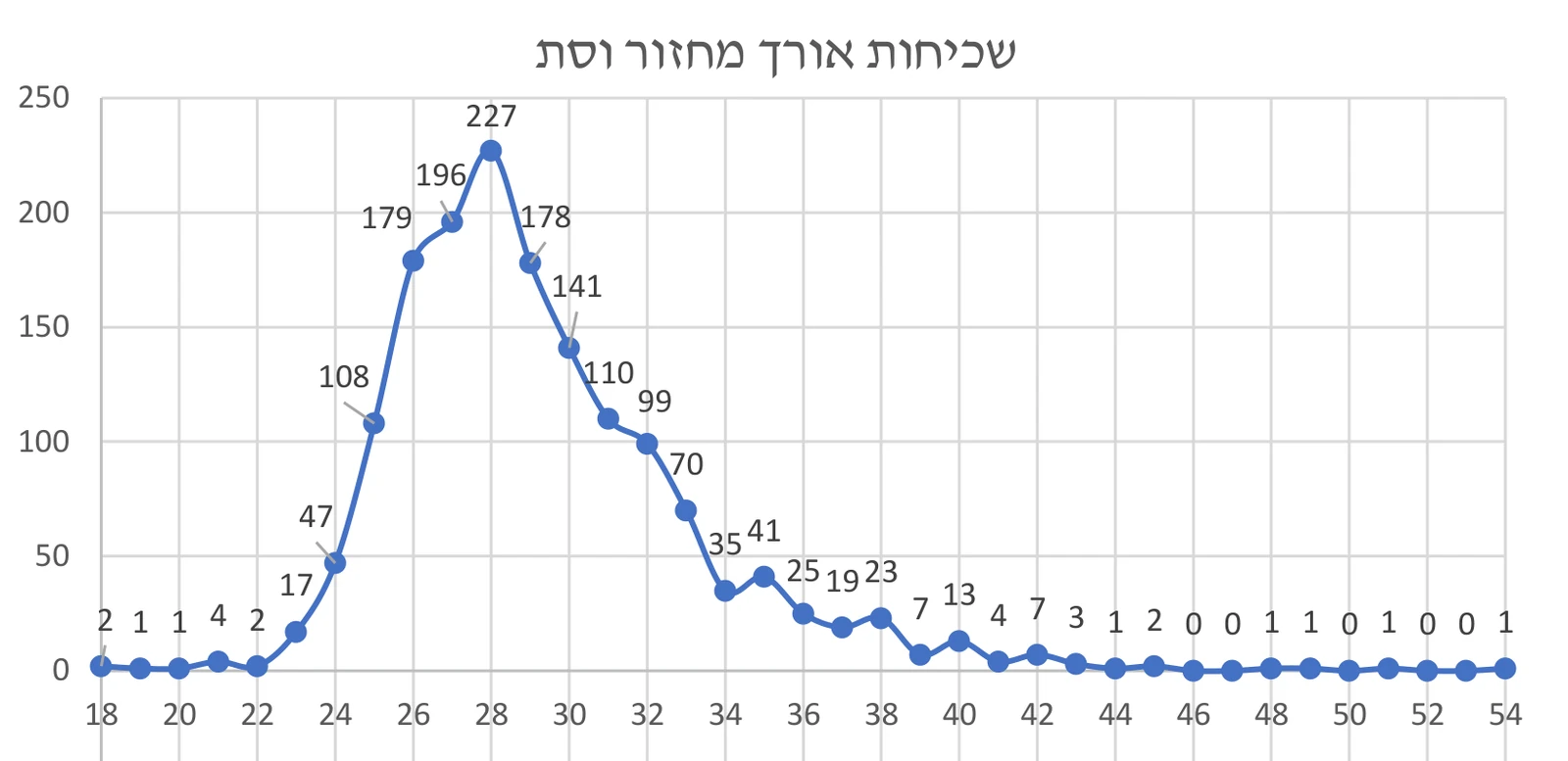
Line chart of how many cycles had each length from 18 to 54 days, rising to a single peak at 28 days and tailing off toward longer cycles. Labels are in Hebrew.
Observed cycle-length distribution, with the strongest concentration around 28 days. Source: author manuscript, p. 4.
2022Hebrew

Markov Chain for the 'Interval Menstruation'

שרשרת מרקוב לווסת ההפלגה

B.D.D. – Bekhol Derakhekha Daehu · vol. 36 · pp. 77–104

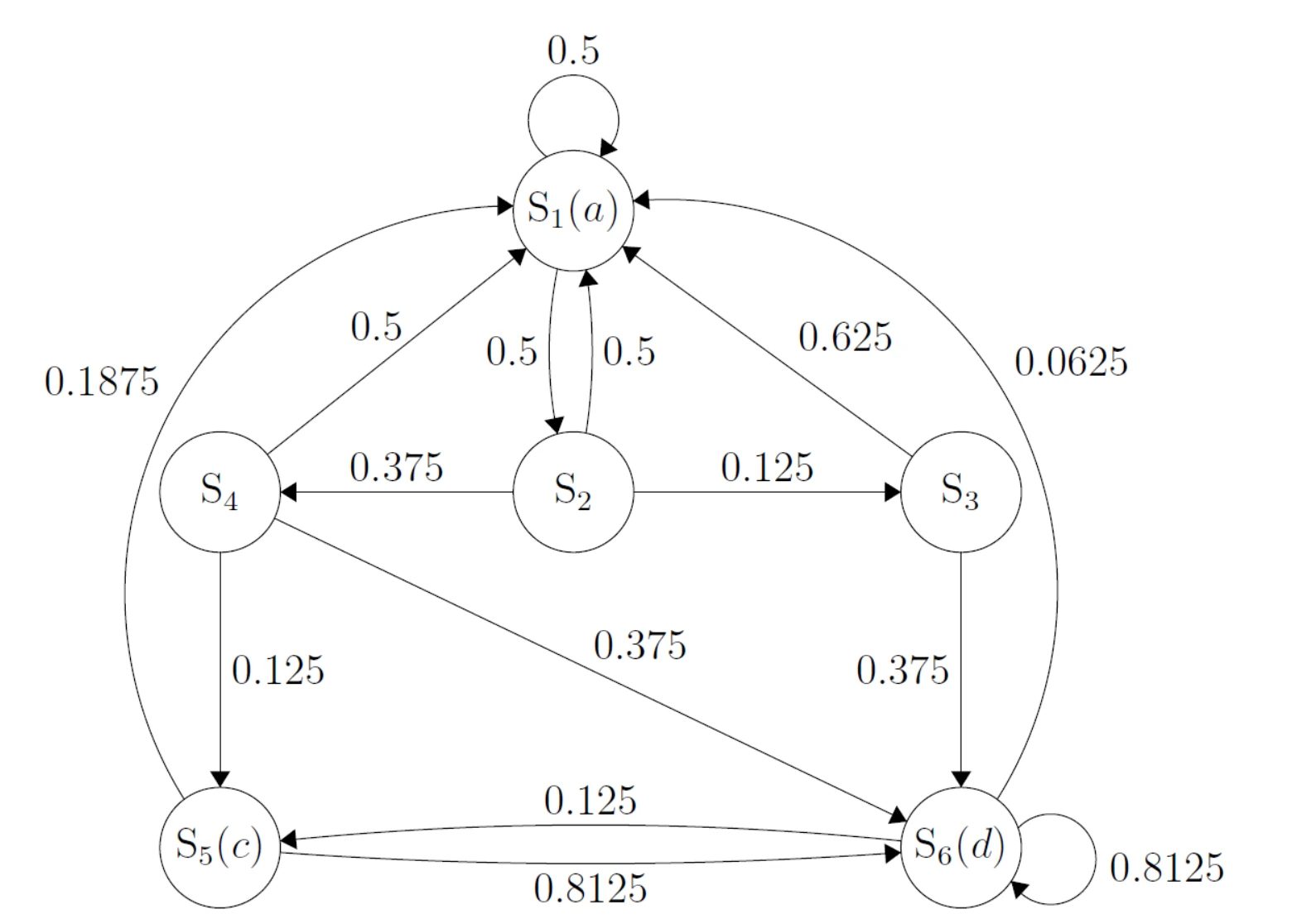
Builds a Markov-chain model of the "interval" (fixed-difference) menstrual pattern, finds its stationary distribution and proves convergence, to estimate how likely a woman with a consistent pattern is to stay in it over time.

Directed graph of a six-state Markov chain, states S1 to S6, with a transition probability on every arrow and self-loops on S1 and S6.
A six-state Markov representation of the interval-pattern model, with example transition probabilities. Source: Ph.D. dissertation, PDF p. 98 (thesis p. 93); same diagram as in the journal article.
2019Hebrew

Reliability of Menstrual Cycle Reporting in Surveys with Regard to Jewish Religious Laws

אמינות דיווחים על וסתות בהקשר הלכתי

Functional Differential Equations · vol. 26(1–2) · pp. 1–13

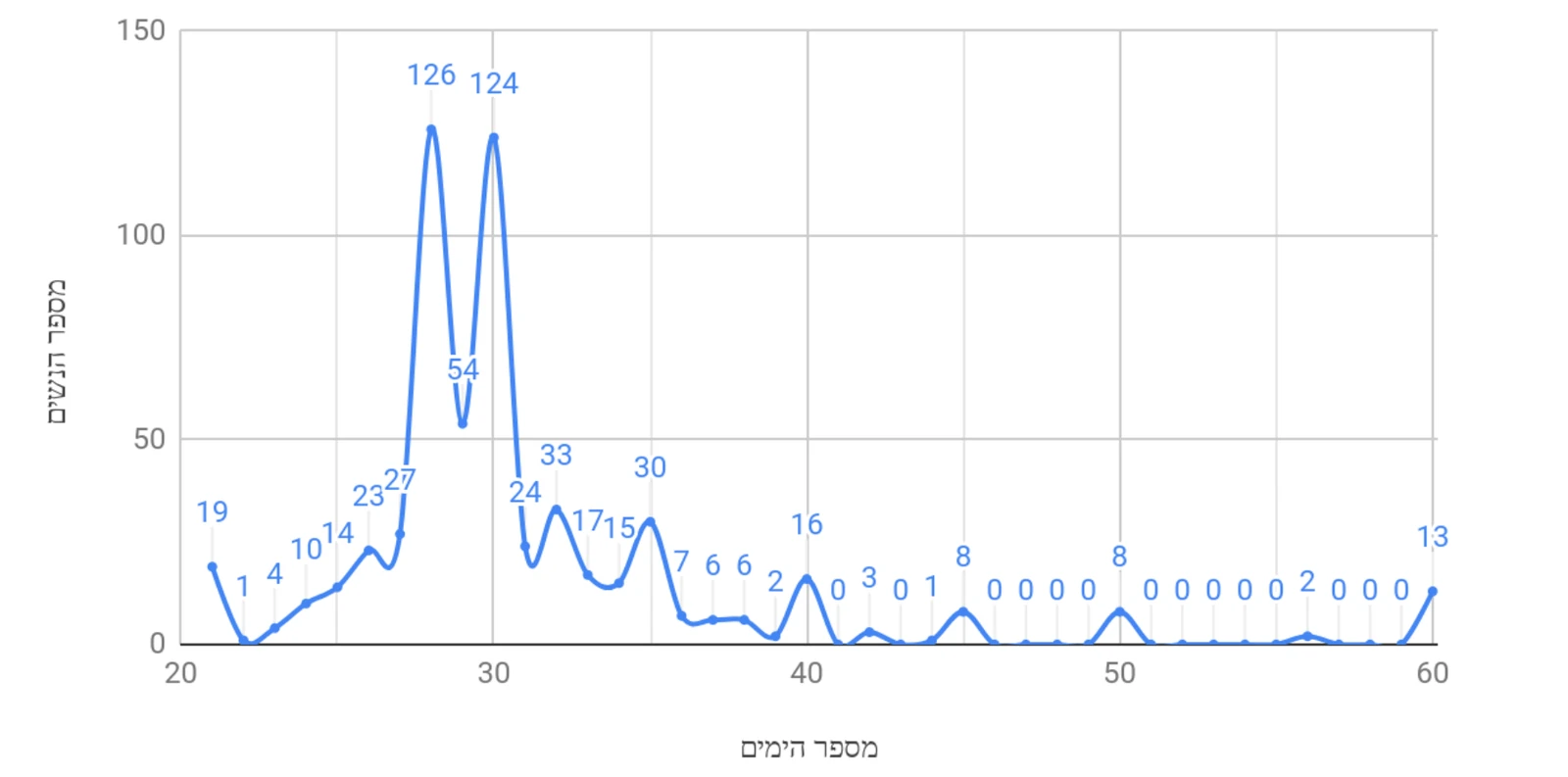
Presents a Markov state model that gives the probability that a woman who reports equal cycle lengths is truly in the "interval" pattern, and uses it to validate a survey of 626 responses.

Line chart of reported monthly cycle lengths from 20 to 60 days with two tall peaks at 28 and 30 days and smaller spikes at round numbers such as 35, 40, 45 and 50. Labels are in Hebrew.
Reported cycle lengths show heaping at conventional and round-number values, one of the signals motivating the reliability analysis. Source: Ph.D. dissertation, PDF p. 11 (thesis p. 6), where the chapter is the published article.
Doctoral research

Ph.D. dissertation

2022Ph.D. dissertationHebrew

Probabilistic and Statistical Analysis of the Menstrual Cycle with regard to Jewish Religious Laws

ניתוח הסתברותי וסטטיסטי של מחזור הווסת בהיבט הלכתי

Dvir Jacob Ross · Ariel University

The first study to examine the Jewish-law rules for predicting menstruation with modern statistical tools: validating survey data, testing the frequency of each rule against a controlled dataset by simulation, and building probabilistic models of the "interval" and "semi-fixed" patterns.

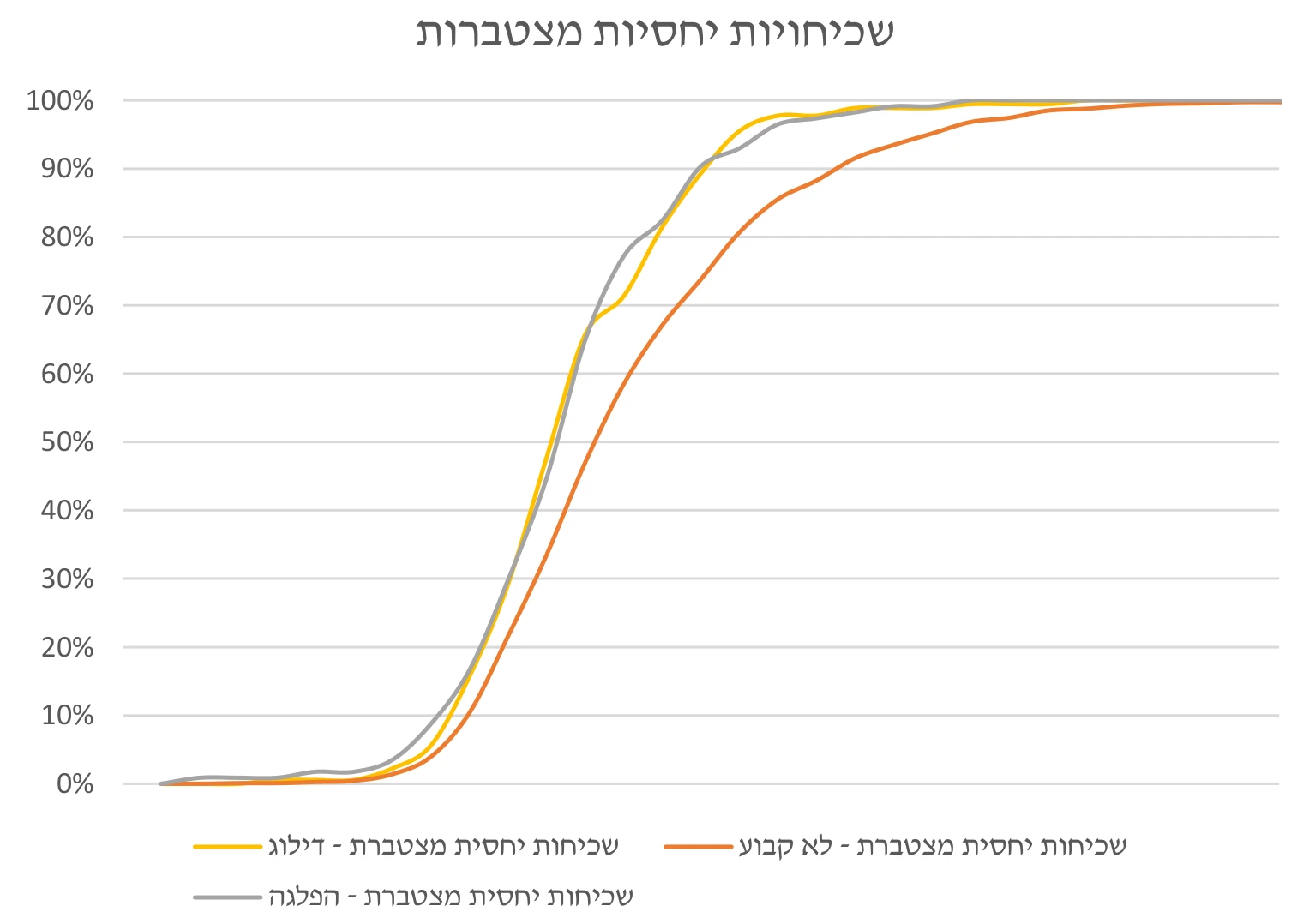
Three S-shaped cumulative frequency curves of cycle length, one each for the interval, skipping and non-fixed onset patterns; the non-fixed curve rises more slowly than the other two. Labels are in Hebrew.
Cumulative cycle-length distributions for interval, skipping and non-fixed onset patterns, the groups that differed most in the thesis comparison. Source: Ph.D. dissertation, PDF p. 80 (thesis p. 75).
Talks & conferences

Recent research presentations

2026

Modeling Basketball Shooting Patterns Using Markov Chains: A Longitudinal Analysis of the Hot Hand Phenomenon

ADTM 2026 Conference · SCE Beer Sheva · supported by IEEE

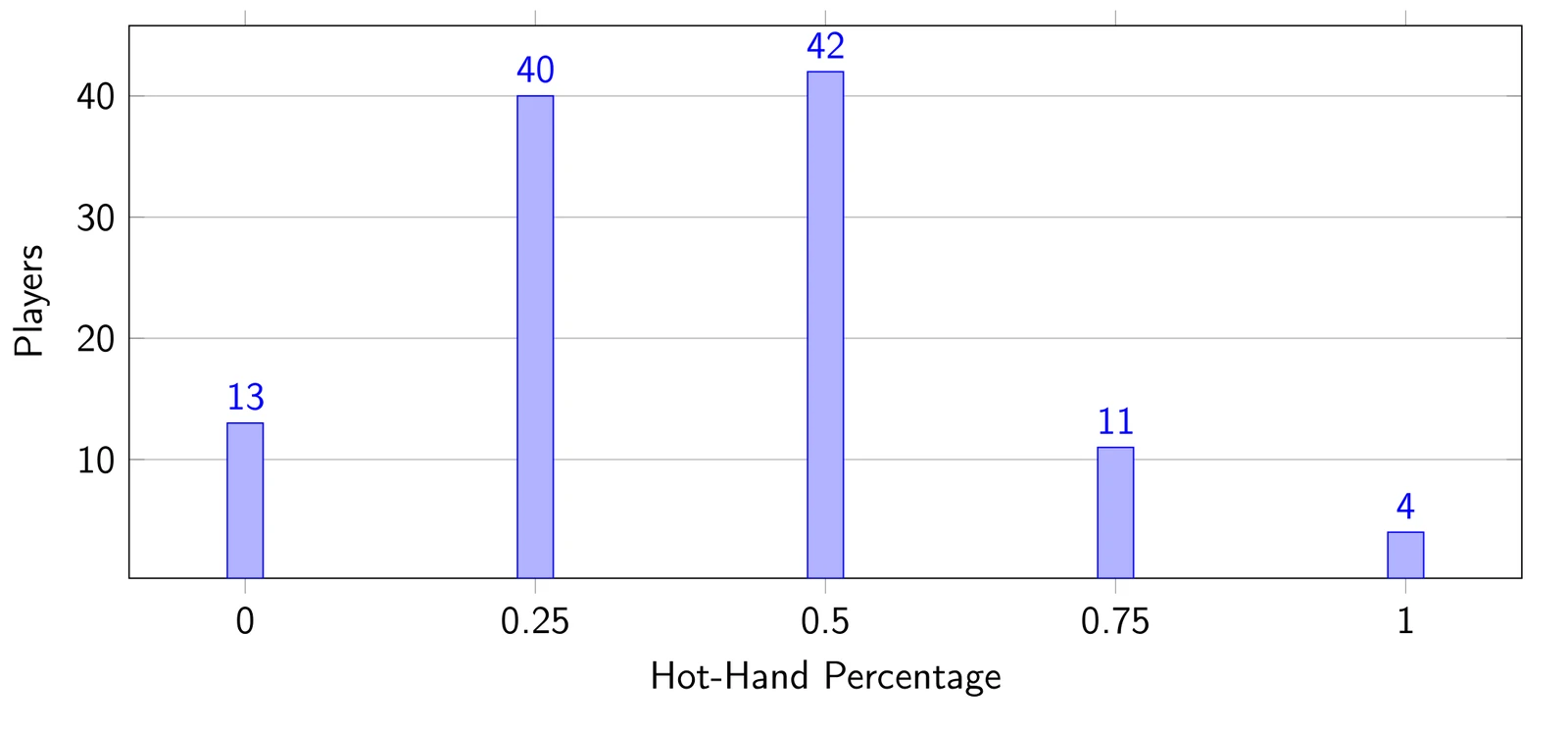
Bar chart of the number of players at each hot-hand percentage from 0 to 1 (13, 40, 42, 11 and 4 players), concentrated at 0.25 and 0.5. The 110 players are those with significant first-order dependence.
Among players with statistically significant first-order dependence, most show only moderate hot-hand percentages. Source: ADTM 2026 presentation, slide 16.
2026

Data-Driven Risk-Adjusted Performance Analysis: A Structural Complement to Classical Risk-Adjusted Ratios

ADTM 2026 Conference · SCE Beer Sheva · supported by IEEE

Related supervised project, with Nehoray Sade and Aviv Asraf →

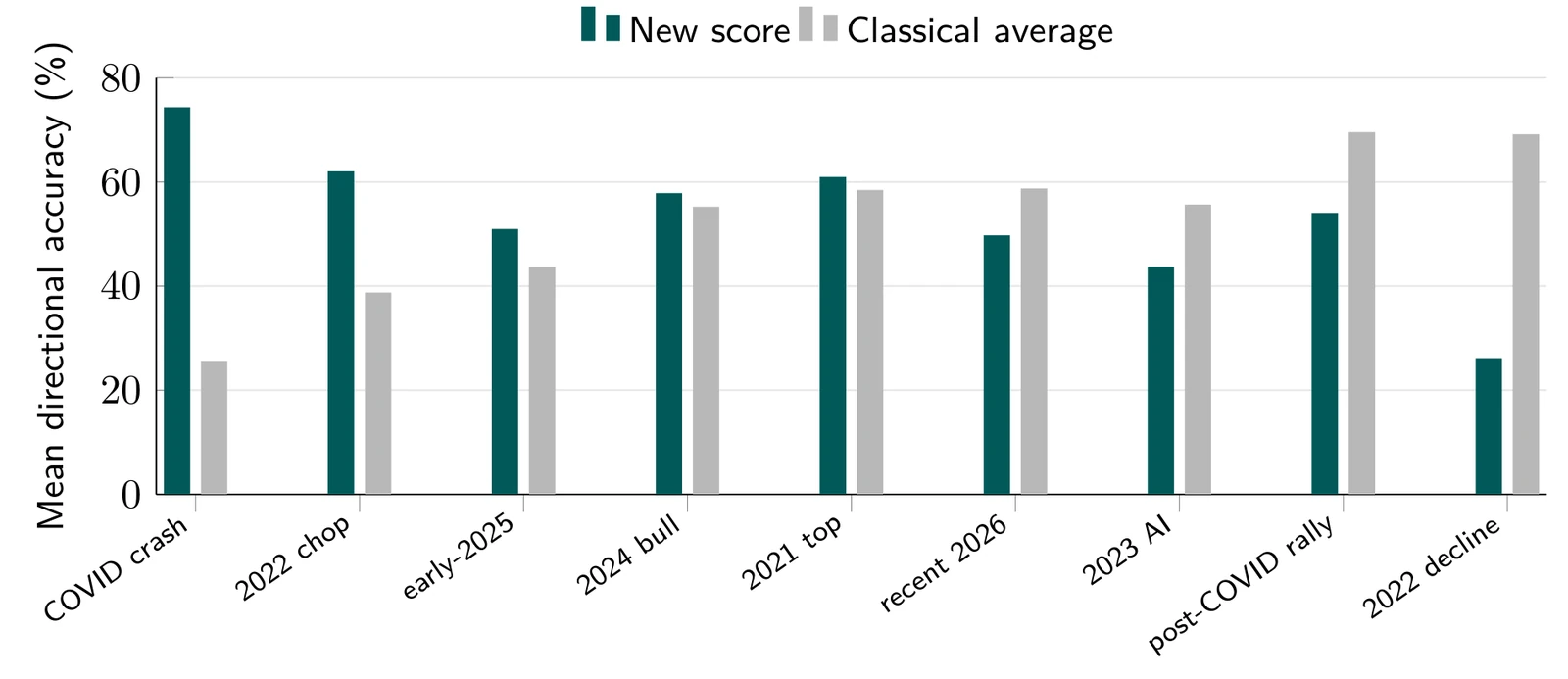
Paired bar chart of mean directional accuracy in percent for the new structural score and the classical-ratio average across nine market regimes; the new score is higher in the COVID crash and 2022 chop, and lower in the post-COVID rally and 2022 decline.
Directional accuracy changes by market regime: the structural score leads in some reversal and choppy periods, while classical ratios lead in sustained trends. Source: ADTM 2026 presentation, slide 12. Supervised work by Nehoray Sade and Aviv Asraf.
2026

Modeling Shooting Streaks with Markov Chains

Graduate Research Seminar · Shenkar · May 27, 2026

Related ADTM 2026 presentation on the same topic →

Talk details

This lecture presented a data-driven analysis of NBA shot sequences using first- and second-order Markov-chain dependence tests. The study models shots by outcome and shot type, uses a two-decade NBA dataset, and finds some short-term dependence without evidence for a strong or consistent hot hand effect.

2025

Succeeding Even When You Make Mistakes: How to Get Inside the Examiner's Head?

להצליח גם כשטועים, איך נכנסים לראש של בוחנים?

From Academia to High-Tech 2025: The Road to the Degree · March 2–4, 2025

Talk details

Talk by Dr. Dvir Ross at the event "From Academia to High-Tech 2025: The Road to the Degree" (Hebrew: מהאקדמיה להייטק 2025 – הדרך אל התואר), held March 2–4, 2025. The organizer's page lists the event, its dates, the speaker and the talk title.

2021

Probability and Statistics in the Religious Laws of Menstruations

הסתברות וסטטיסטיקה בהלכות וסתות

27th Conference on Judaism and Science · Bar-Ilan University · March 18, 2021

Academic mentorship

Supervised student projects

Selected capstone and research projects across quantitative finance, NLP, network analysis, navigation, algorithms, and software systems, with abstracts, methods, visuals, demos, and research outcomes added as materials are consolidated.

Explore supervised projects →
Teaching & learning

Academic courses

Course pages in mathematics and computer science, with learning materials and visual explanations added progressively.

Explore academic courses →
Research pipeline

Current projects

Hot Hand Modeling

First- and second-order Markov-chain models for longitudinal basketball shooting behavior.

Risk-Adjusted Performance

Developing structural measures that complement classical Sharpe/Sortino/Calmar-style evaluation.

Wikipedia Sockpuppet Detection

NLP, network analysis, and higher-order response structures for identifying coordinated identities.

Agent-Based Tag

Geometric and directional awareness in agent-based pursuit and tag environments.