The rate of convergence: a weak bound and a strong ratio
How many digits a method gains per step: the error, linear convergence in a weak sense (bisection) and in a strong sense (regula falsi with a fixed end), the order of convergence, and a proof that the ratio of convergence is 1 − f′(r)/f[a, r].
Last updated:
On the two previous pages we ran two methods on the same equation:
bisection and regula falsi. Here we define exactly what “fast” means, and measure it for both methods, in two senses:
weak and strong.
Weak and strong: the English terms Q-linear and R-linear
“Weak” and “strong” are this course’s words; the English literature uses two other names, and each is a different statement about the errors .
- R-linear (R for “root”): the errors are bounded by a sequence that itself converges linearly, with . This is our weak sense. Bisection has it with , although a single error may rise from one step to the next.
- Q-linear (Q for “quotient”): the ratio of consecutive errors stays below a constant smaller than , for all large . Our strong sense is a special case: the ratio has a limit in . Then from some step on the errors really fall at every step.
Q-linear implies R-linear, and not the other way round: bisection is the counterexample.
The two terms are not “weak” and “strong” in any other sense:
the phrase “weak convergence” in functional analysis is an unrelated notion.
For more, see the rate of convergence on Wikipedia.
The error and digits per step
Write for the root and for the approximation after steps (in bisection , in regula falsi the new point); the error is .
A decimal digit is a factor of 10, so a method that multiplies the error by at every step gains correct digits per step.
The weak sense: bisection
In bisection the error itself need not fall at every step: in the table of bisection is closer to the root than .
Bisection gives no guarantee that the ratio converges; what always holds is the bound (we proved it), a sequence that halves at every step and bounds the error.
This is linear convergence in a weak sense: the error is bounded by a sequence that converges linearly, with ratio .
The weak sense uses only the bound; the strong sense below needs a limit of the ratio of the errors.
Calculate: How many digits does the bound gain per step?
How many steps does it take to gain one digit?
Solution
digits per step. One digit (a factor of 10) takes about 3.3 steps:
, so ten steps are about three digits. This holds for the bound; at a particular step the real error may fall less, or more.
The strong sense: regula falsi with a fixed end
In regula falsi, when one end stays fixed (for example for a convex or concave ) and is differentiable at the root, the ratio itself settles (we prove this below):
This is linear convergence in a strong sense with ratio :
each step multiplies the error by about .
Why is it called linear and not constant, when the ratio is constant?
The ratio is constant, but the error is not: it falls. From we get , so
is a linear function of : a straight line on a semi-logarithmic graph, with slope .
The number of correct digits grows by the constant per step, that is, linearly in .
In quadratic convergence (see the order of convergence below) the number of digits is doubled at each step, a much faster growth.
Calculate: In the table of regula falsi on the monthly payments (on its page) .
Compute , and and the ratios and .
How many digits are gained per step?
Solution
(; a positive error means that the approximation is above the root), , so , and then , and .
The ratios are and (the error falls about 14-fold at each step), so and digits per step, 3.8 times the bound of bisection.
In four steps, from to , the error falls by a factor of about , about digits ().
For comparison, with (bisection) a step gains digits and ten steps about 3 digits; with a whole digit is gained at every step.
| Function | Digits per step | |
|---|---|---|
| Bisection, the bound (weak sense) | ||
| Regula falsi, the monthly payments | ||
| Regula falsi, the loan of the practice | ||
| Regula falsi, on |
The table raises the question of what decides : below we prove a formula that computes it.
The order of convergence
The order of convergence is the number for which the ratio tends to a number (when we also require : linear convergence, with ).
Order 2 means : an error of is followed by about , so the number of correct digits roughly doubles at each step.
Three sequences of errors for comparison, without any method:
(the ratio tends to 1, slower than linear), (linear, ) and (quadratic: , and the digits double at each step).
The two methods of this lecture are linear; methods in which the number of correct digits doubles at each step belong to the methods of unit 2 that come later.
Compute. Three sequences of errors, without any method, are defined by A:
, B: and C: , ; the table gives their first three terms.
For each sequence compute and , from the table, and decide its order (or that it is slower than linear); the rule of each sequence shows how its ratios continue.
| sequence A | sequence B | sequence C | |
|---|---|---|---|
| 1 | 0.5 | 0.3 | 0.1 |
| 2 | 0.3333 | 0.09 | 0.005 |
| 3 | 0.25 | 0.027 | 0.0000125 |
Solution
Sequence A: the ratios are and and keep growing toward 1 (the sequence is ):
slower than linear. Sequence B: both ratios are , so it is linear with (a gain of digits per step).
Sequence C: is and and falls to 0, while both times:
order with .
Proof: why the ratio is what it is, and the derivative at the root
The ratio of regula falsi depends on the shape of . We compute it when the function is convex, the fixed end is , the moving end is , and (with , and for the moving end is the new point of iteration : ).
We use the divided difference, the slope of the chord through two points of the graph:
For example, for we get . The derivative is its limit:
is differentiable at when approaches a number as .
Applying the same idea to the slopes gives the second-order form :
it measures how much the slope changes from one chord to the next (for it is always , and it is never negative for a convex function, positive for a strictly convex one).
Work it out: The chord through the ends is . Show that .
Solution
, so . By definition , so , and the formula follows.
Put and : . The new point satisfies , so .
Hence, with and ,
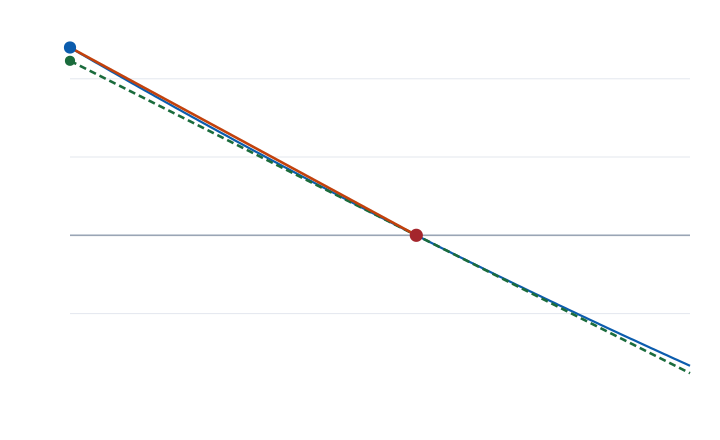
The two slopes of the formula, for the monthly payments (the figure is computed from the function itself):
the chord from the fixed end to the root has slope , the tangent at the root has slope , and their ratio gives .
The last step of the proof shows why this is the limit of the ratio of the errors.
Since , we have and (this is the definition of the derivative, and here we need that is differentiable at ), so .
Substituting:
The ratio is a quotient of two slopes: the tangent at the root, and the chord from the fixed end to the root.
For a convex function they have the same sign and (the slopes of a convex function grow from left to right), so when .
The derivation does not use which side of the root is on:
is the fixed end, left or right. The formula needs three conditions:
- from some step on, the end does not move;
- is differentiable at (the limit step above uses it);
- .
Convexity guarantees the first condition and . The value occurs when is linear:
the first chord point is then already the root, and the strong sense above (which needs ) does not apply.
What if is not differentiable at ?
Without differentiability the ratio is governed by the one-sided derivative, on the side of the moving end.
Calculate for the monthly payments, where is the value of the six payments at the monthly rate minus 1200:
, and the slope at the root is about . What is ?
And at the fixed end of , where ?
Solution
For the monthly payments , so , the ratio measured in the table (14.1 times smaller at each step).
For the slope from the fixed end is , so , and the error falls only 1.3 times per step (0.12 digits).
The more the curve bends, the steeper the slope from the far end compared with the tangent at the root, and the ratio approaches 1:
for it is already .
A full tutorial on regula falsi, and a short video on running it step by step with the CALC function of a scientific calculator:
The same step on the calculator emulator is practised in the practice session, by hand with a table.
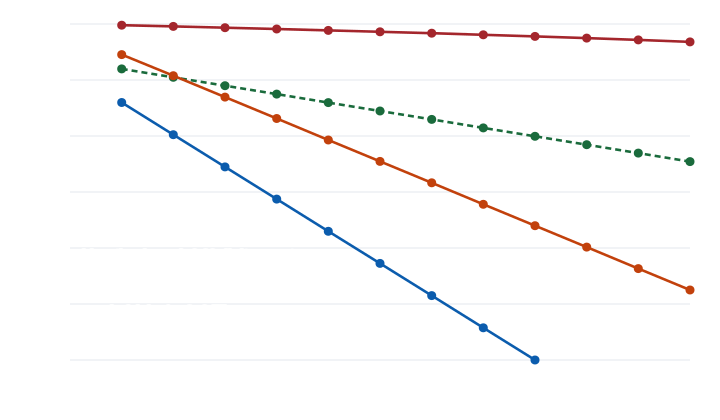
In the figure we see the base-10 logarithm of the size of the error against the step:
for each method a straight line whose slope is negative.
The number of digits gained per step is minus the slope, :
0.30 for the bound of bisection, 1.15 on the monthly payments, 0.77 on and only 0.12 on .
The example with a fixed end is a close to 1.
What we can check without knowing the root: the step ratio
We cannot compute the error without knowing , but we can compute the step , and the ratio of the steps .
When the error falls by a factor at every step and the points approach the root from one side, and , so the ratio of the steps is also and the size of the error is
(the sign of is the side from which the points approach: negative from the left, as in ).
When is small, the error is much smaller than the last step.
When is near 1 it is much larger: at nine times, at ninety-nine times.
For the ratio of the steps is , and the error is times the last step:
stopping on a small step stops far from the root. A ratio near 1 is a signal to switch to another method, bisection or regula falsi with a correction (for example the Illinois variant from the regula falsi page).
The explorer shows the column “step ratio” for every method except bisection.
Summary: the rate of convergence
| Method | Sense | Ratio | What decides it |
|---|---|---|---|
| Bisection | weak: the bound | the width of the bracket halves | |
| Regula falsi, convex function | strong: the ratio converges | the tangent at the root against the chord from the fixed end |
Continue learning
The next step is the practice session for the three lectures:
a table by hand, the usual mistakes, transfer questions, including the computation of , and a Python implementation.
Newton–Raphson and the secant method shows methods that gain more digits per step.