Opening unit · Part 3 of 3
The Business Value of Data
Why organizations invest in data: how analytics changes industry, where the business value appears, and where large companies direct money and research.
Industry and leadership change
Analytics and AI change processes, and the work of decision-makers
Here AI means artificial intelligence: computer systems that perform tasks that usually need human judgment, such as recognizing patterns or suggesting an answer. In manufacturing, maintenance can shift from fixing a breakdown to detecting risk in advance. In logistics, forecasts can help plan inventory and routes. In customer service, systems can sort requests or suggest a response. In each example, data connect what is happening in the field to an operational decision.
An industrial feedback loop
Measure → detect a pattern → recommend or predict → decide → evaluate the outcome. Leaders decide what matters, when to trust a system, who can override a recommendation, and how to handle errors or bias.
The change is not simply replacing a worker with an algorithm. It can reshape work sequences, required skills, and how an organization assigns responsibility. Efficiency must be considered alongside reliability, safety, privacy, and effects on workers and customers.
Why do organizations invest in data?
Economic value appears when insight improves action
An organization invests in collection, storage, analysis, and skilled people when it expects better decisions: less waste and downtime, better demand forecasts, improved service, risk detection, or a new offering. A prediction is not the value by itself; value appears when acting on it improves an outcome the organization measures.
Operations
A factory uses machine readings to schedule an inspection before a costly breakdown.
Resource allocation
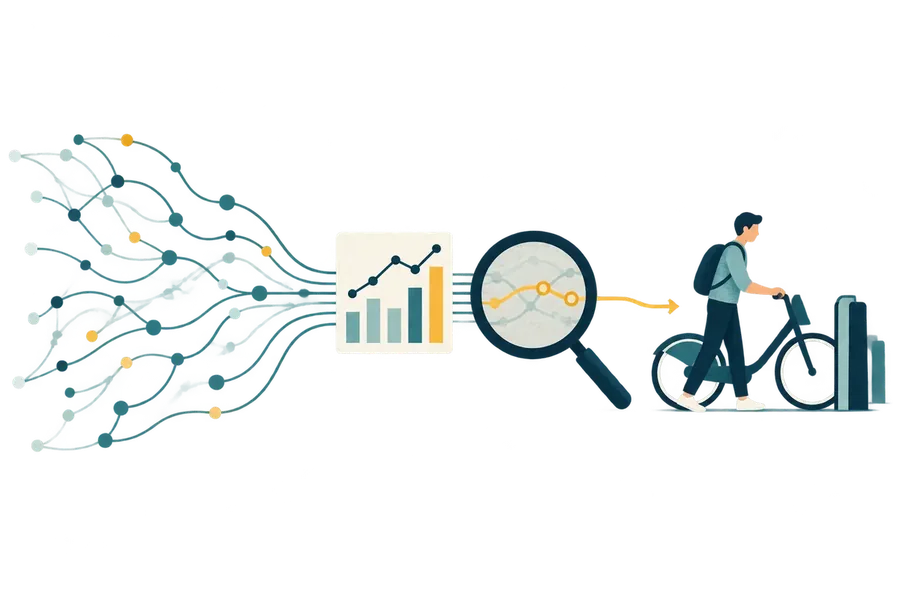
A transit network uses demand forecasts to plan support where and when it is needed.
Service and product
A business learns which user needs recur and adapts its service while protecting privacy.
Before claiming savings or growth, compare with a baseline and include costs, errors, and effects on people. More data collection does not guarantee profit.
Money flowing into the field
Scholarships, competitions, infrastructure, and pay signal economic expectations
Another sign of the importance assigned to this field is the money directed into it: scholarships and training programs, research grants, competitions with prizes or computing resources, company investment in data teams and infrastructure, and product-development budgets for AI.
Scholarships and training
Organizations fund study or training to expand the pool of people with sought-after skills. The Google PhD Fellowship is one example of support for doctoral students in computer science and related fields.
Competitions and challenges
Prizes, data access, or computing resources encourage teams to tackle a defined problem. Kaggle competitions offer examples of challenges with defined tasks and prizes. In Israel, Mafat Challenge is a series of data-science prize competitions open to the public, academia, and industry; winning methods may help enrich the Ministry of Defense’s data products.
Company investment
Companies invest in people, research, data, and computing in the hope of building capability or an advantage.
Pay and roles
Some roles are highly paid, but compensation depends on specialization, experience, industry, and location, and is not guaranteed to everyone who studies the field. For one documented example, the U.S. Bureau of Labor Statistics publishes median pay and job outlook for data scientists in its Occupational Outlook Handbook (United States data only).
Simulation: explore thousands of options before an expensive trial
Instead of building every prototype or running every real-world experiment, a model can simulate different conditions. The simulation produces synthetic data: results generated computationally rather than measured directly. This can screen options, reveal risky scenarios, and focus costly tests on a smaller set of candidates.
Engineering design
Simulate loads, heat, or airflow across designs, then physically build and test the most promising options.
Manufacturing and operations
Simulate production lines, failures, or changes in work rates to compare scenarios without repeatedly stopping equipment or reconfiguring a line.
Medicine and life sciences
Computational models can narrow the materials or conditions worth testing in a lab before moving on to further experiments.
Explore: This TEDx talk by Jeff Heys describes two uses of mathematical models: designing aircraft on a computer, so that only a few of the best designs need wind-tunnel tests (he uses Boeing as the example and estimates savings of tens of millions of dollars), and answering questions where a direct experiment would be ethically problematic, such as how smoke spreads in a restaurant smoking room; NASA’s Aviary shows how aircraft design models can guide choices before costly flight tests.
Savings come when a reliable simulation helps avoid some experiments or choose them better. A simulation alone cannot prove that a solution will work in the real world: validate the model against measurements and run follow-up trials as needed.
Investment reflects an expectation of value and demand; it does not prove every project will succeed or every role will be lucrative. Pay and demand differ by country, year, and specialization. As one dated example, see the U.S. Bureau of Labor Statistics Occupational Outlook Handbook entry for data scientists; it describes the United States, not Israel.
Companies and research
Where large companies direct data investment and research
This chapter looks at how a few large technology companies spend on data and AI, and at the kinds of data research they publish. Each company invests in ways that fit its business, and the examples are illustrations, not a ranking.
Where do major companies direct that investment?
At large technology companies, investment includes data centers and chips, research teams, model training, and integrating these capabilities into products.
Reported $91.4 billion in capital expenditures for 2025 and expects to increase its investment in technical infrastructure, including servers, network equipment, and data centers.
Said in January 2025 that it planned to spend about $80 billion on AI-enabled data centers in its 2025 fiscal year, with more than half of that in the United States.
Amazon Web Services (AWS) is Amazon’s cloud-computing business. Amazon announced a further $5 billion investment in Anthropic in April 2026, alongside an agreement for Anthropic to use up to 5 gigawatts (a measure of electric power, and so of computing capacity) of Amazon’s Trainium chips (processors Amazon designed for training AI models), linking an AI-lab partnership to cloud computing capacity.
In 2006, Netflix announced a $1 million prize for a team that could improve the prediction accuracy of its Cinematch recommendation system by 10%.
The amounts above measure different things for different years: capital expenditure that was reported, a spending plan for a fiscal year, an investment in another company, and a prize. They show the variety of investment, not a ranking, and they cannot be added or compared directly.
Data research at major companies: four different directions
Large companies research a wide range of problems, from data-processing infrastructure to experiments and forecasting. These examples show that variety; each link leads to a source publication.

Google research
Processing data that keeps arriving: The Dataflow model addresses large streams of data, such as usage events and sensor readings. It describes ways to balance processing speed, result correctness, and cost.
Original paper: The Dataflow Model ↗Microsoft Research
Causality from data: Running an experiment is not always possible, so sometimes we only have data collected as events happened, such as sales figures or medical records (observational data). DECI tries to learn from such data what influences what, and to estimate the effect of an intervention, such as changing a price. These methods also rely on assumptions; correlation alone does not prove causation.
Original publication: Deep End-to-end Causal Inference ↗
Netflix research
A/B testing and research infrastructure: This paper describes a platform that lets data scientists run A/B tests (comparing two versions of a product on different groups of users), measure their effects, and use a range of statistical methods at scale.
Original paper: Engineering for a Science-Centric Experimentation Platform ↗
Amazon research
Demand forecasting and uncertainty: DeepAR learns patterns across many time series to forecast future demand. Instead of returning only one number, it estimates a distribution of possible outcomes, which is useful for inventory planning.
Original paper: DeepAR ↗Recommendations remain another example of data science at these companies: Google published work on YouTube recommendations, Microsoft shared the MIND dataset, Amazon described item-to-item recommendations, and Netflix researcher Xavier Amatriain wrote about mining large streams of user data for personalized recommendations. Google ↗ · Microsoft / MIND ↗ · Amazon ↗ · Netflix ↗
This investment especially accelerates the development of frontier models (the most capable AI systems of their time): capital can fund infrastructure, large research teams, and experiments at scale. According to the AI Index 2026 from Stanford’s Institute for Human-Centered AI (HAI), industry produced over 90% of notable models in 2025. Industry is a leading force in frontier model development, but it does not conduct all research in the field. The figure counts notable models, not the money behind them.
What does this mean for our course? Companies are moving fast, but to understand and evaluate the tools they build, we start with the foundations: data, questions, analysis, and critical thinking.
Key points
- Economic value appears when an insight improves an action and the outcome is measured against a baseline, including costs and errors.
- Investment signals expectations about value and demand; it does not prove that every project will succeed or every role will pay well.
- A simulation helps focus costly tests, but it must be validated against measurements.
- Large companies invest in different ways, from infrastructure to research and prizes. Check the source before repeating a number.
Check yourself
A forecast predicts which stations will run short. What must be true for it to create business value?
Show a possible answer
Acting on the forecast improves an outcome the organization measures, compared with a baseline, after counting costs and errors.
Why is a simulation result not proof that a design will work?
Show a possible answer
The model is a simplification. It must be validated against real measurements, with follow-up trials where needed.
A report says industry produced over 90% of notable AI models in a year. Does this mean universities do little AI research?
Show a possible answer
No. It describes the share of notable models, not of all research; academia also publishes much of the field’s research.