OnBeat
A system that adapts the music a person hears during exercise to their workout intensity in real time, using physiological and activity signals from a wearable.
Music that adapts to workout intensity.
OnBeat is a final project from Shenkar's Software Engineering Department. Instead of a fixed playlist, it adapts the music during exercise to the intensity of the workout, as indicated by heart rate and other activity signals from a wearable device.
The system combines a smart ring, a mobile application, backend services and recommendation logic in a single product.
Recognition
Outstanding Final Project, Shenkar, 2025.
Four parts of one system.
Wearable data
A smart ring provides the physiological and activity signals that the system responds to.
Mobile application
The user-facing application is built with React Native.
Backend services
Backend services are implemented in Python.
Recommendation logic
Recommendation logic chooses music in response to the measured intensity of the workout.
The team documented the project in a proposal, a software requirements specification, a validation report and a final Project Book.
A feedback loop between heart rate and music.
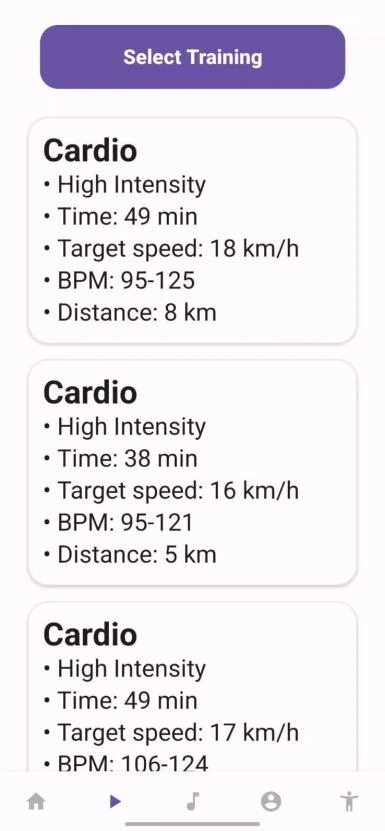
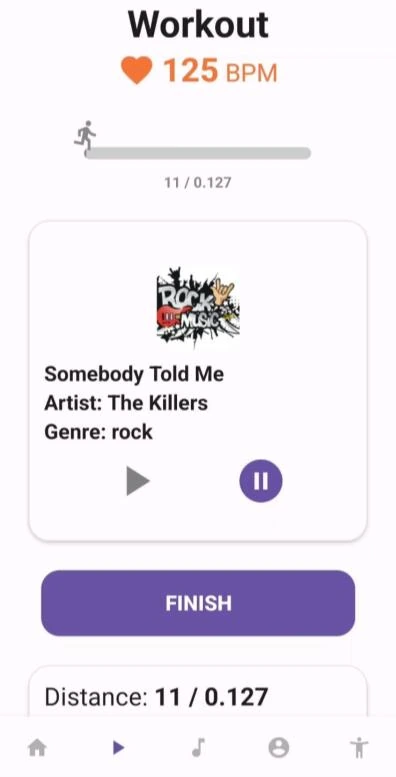
The ring reports heart rate every second. OnBeat compares it with a target zone for the chosen workout, which depends on the runner's age and BMI group, and changes the music whenever the runner drifts outside that zone.
Workout phases
Each run has a beginning, middle and end. Early on, energetic tracks help raise heart rate toward the target; in the middle, tempo-matched tracks help hold it; at the end, tempo falls gradually to support recovery.
Choosing a song
Candidates are filtered by tempo, preferred genre and songs not yet played. A LightGBM model predicts how well each would work, adjusted by how effective that song has been before, and the highest score plays.
Adapting in real time
Playback speed changes immediately: faster if heart rate is too low, slower if too high. If it is still outside the zone after 40 seconds, the system switches to a song with a more suitable tempo.
New users (cold start)
With no listening history, the system borrows from similar users, matched on BMI group, age range, preferred genres and workout goal, and later retrains from stored session results.
Within-subject testing with and without adaptive music.
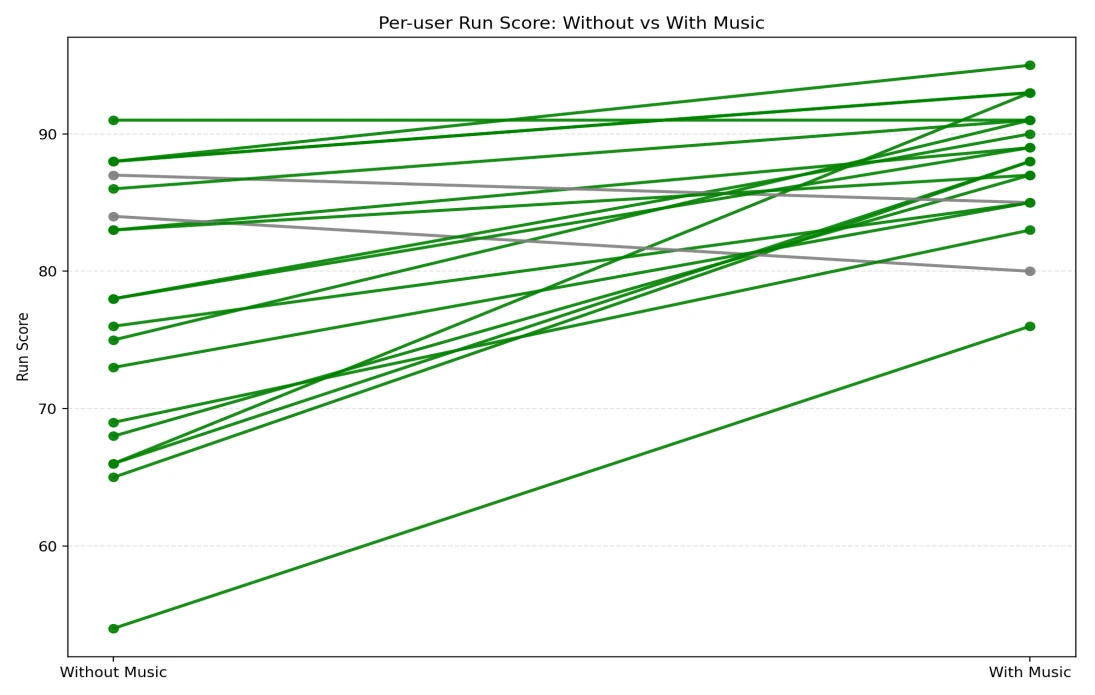
The student final report describes a validation study with 20 participants, each completing one comparable run without music and one with OnBeat, so every participant is their own control. Reported results: a mean run score of 77.3 without music and 87.95 with OnBeat (+10.65 points, +13.8%), heart-rate-zone compliance of 81.4% without and 92.6% with (+11.2 percentage points), and a higher run score for 17 of 20 participants (85%).
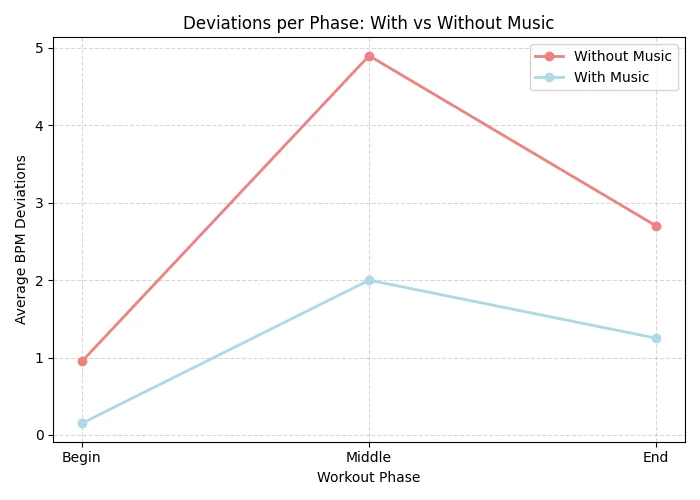
The report also records fewer BPM deviations in the beginning, middle and end phases when adaptive music was used, with the largest average reduction in the middle phase.
What the metrics mean. The run score is the project's own indicator, computed during a session from how closely heart rate stays inside the target zones; deviations deduct points (the report's event log shows a small BPM deviation costing 2 points). Zone compliance is the share of the run spent inside the target zone. BPM deviations count how often heart rate left the range in each phase.
These are results reported in the supervised student project's final validation study.
Validation design
- 20 participants
- Within-subject comparison
- Runs with and without adaptive music
- Run score and heart-rate-zone compliance, logged by an admin dashboard
Most participants improved, a few did not.
Averages can hide spread, so the report also plots each participant's two scores. Most lines rise from the without-music score to the with-music score; the grey lines mark participants whose score did not improve.
What this study does not cover.
Small, single-condition sample
The validation used 20 participants with one run per condition. The report notes that testing was limited to a small number of users, so large-scale behaviour is not validated.
Own metric
Run score is defined by the project and tied to its target zones, so it measures staying in zone rather than an independent fitness outcome.
Fixed music and workouts
The system uses a predefined library of songs with annotated tempo, and a fixed set of workout templates, which limits personalization.
One sensor
Validation used a single smart ring model (Colmi R06). Other wearables were designed for but not tested.
Final report, official page and coverage.
The student final report, Shenkar's graduate project page and press coverage of the project.
Final project, Shenkar Software Engineering, 2024–2025.
Built by Maayan Babayoff, Lotem Yaakobian and Nikolai Melnichev.