TradeMind
An interpretable algorithmic-trading research platform that models market states probabilistically and converts those forecasts into risk-aware analysis and portfolio-allocation recommendations.
What is the distribution of tomorrow’s return, given the recent market state sequence?
Rather than producing a single deterministic “up/down” call, TradeMind discretizes daily returns into a ten-state space and estimates conditional transition probabilities from recent state histories. A variable-order mechanism backs off to shorter contexts when longer histories have insufficient observations.
The broader engineering question is how to combine those probabilistic forecasts with conventional indicators in a system that remains transparent enough for a user to inspect why a recommendation was produced.
Primary objectives
- Probabilistic next-state forecasting
- Technical-indicator integration
- Risk classification
- Interpretable scoring
- Portfolio allocation
- Interactive visualization
From OHLCV data to state-conditional decisions
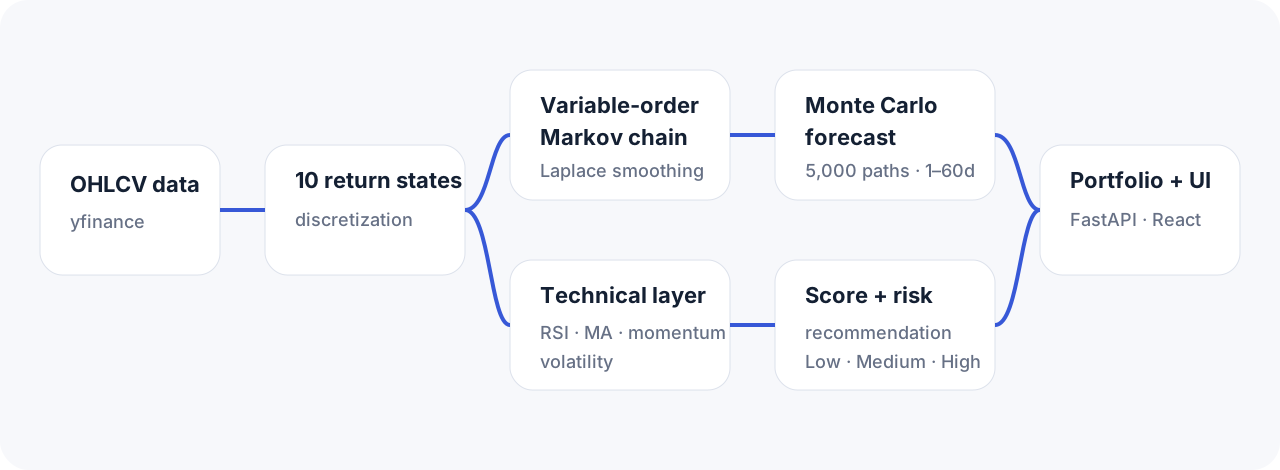
An interpretable quantitative stack
Variable-order Markov model
Transition probabilities are estimated from historical state sequences with Laplace smoothing. The model uses the longest observed context available and backs off when needed.
Monte Carlo horizon forecast
Thousands of simulated state paths propagate the one-step transition model across configurable horizons, producing a distribution rather than one point estimate.
Technical & risk layer
RSI, moving averages, momentum and volatility are combined with the probabilistic forecast in a transparent multi-component scoring and risk-classification layer.
The forecast is evaluated as a probability distribution.
The final system compares predicted next-state probabilities against the realized state using the Brier Score, which is appropriate for probabilistic forecasts. This is preferable to judging the model only by whether its most likely state happened to be correct.
The application also exposes transition matrices, state distributions and the components of its recommendation score, keeping the modeling process inspectable.
Delivered system
- Automated yfinance data ingestion
- Python / FastAPI backend
- React dashboard
- Directed state-transition visualization
- Multi-asset analysis
- Live deployment
The difficult parts are exactly where quantitative systems usually break.
Non-stationarity
Transition behavior changes across regimes, so probabilities learned from one market environment can become stale.
State-space explosion
Longer context histories can become too sparse. Variable-order backoff is a direct response to this problem.
Trading frictions
The current system does not fully model slippage, transaction costs and short-borrow constraints, all of which matter for real deployment.
Backtesting depth
The report identifies a comprehensive multi-cycle backtest against static benchmarks as an important next step before making stronger performance claims.
Final report, source code and live application.
The student final report, the public repository and the deployed web application.
A working research prototype, not a black-box “trading signal.”
TradeMind’s main contribution is the integration of probabilistic state modeling, simulation, transparent diagnostics, and a usable software interface into one end-to-end system.